
Green facades in major cities — without maintenance.
Space is becoming scarcer, and cities are becoming greyer. Green facades improve the climate, air quality and noise levels — yet traditional systems often fail due to maintenance issues and costs. Here is an honest overview.
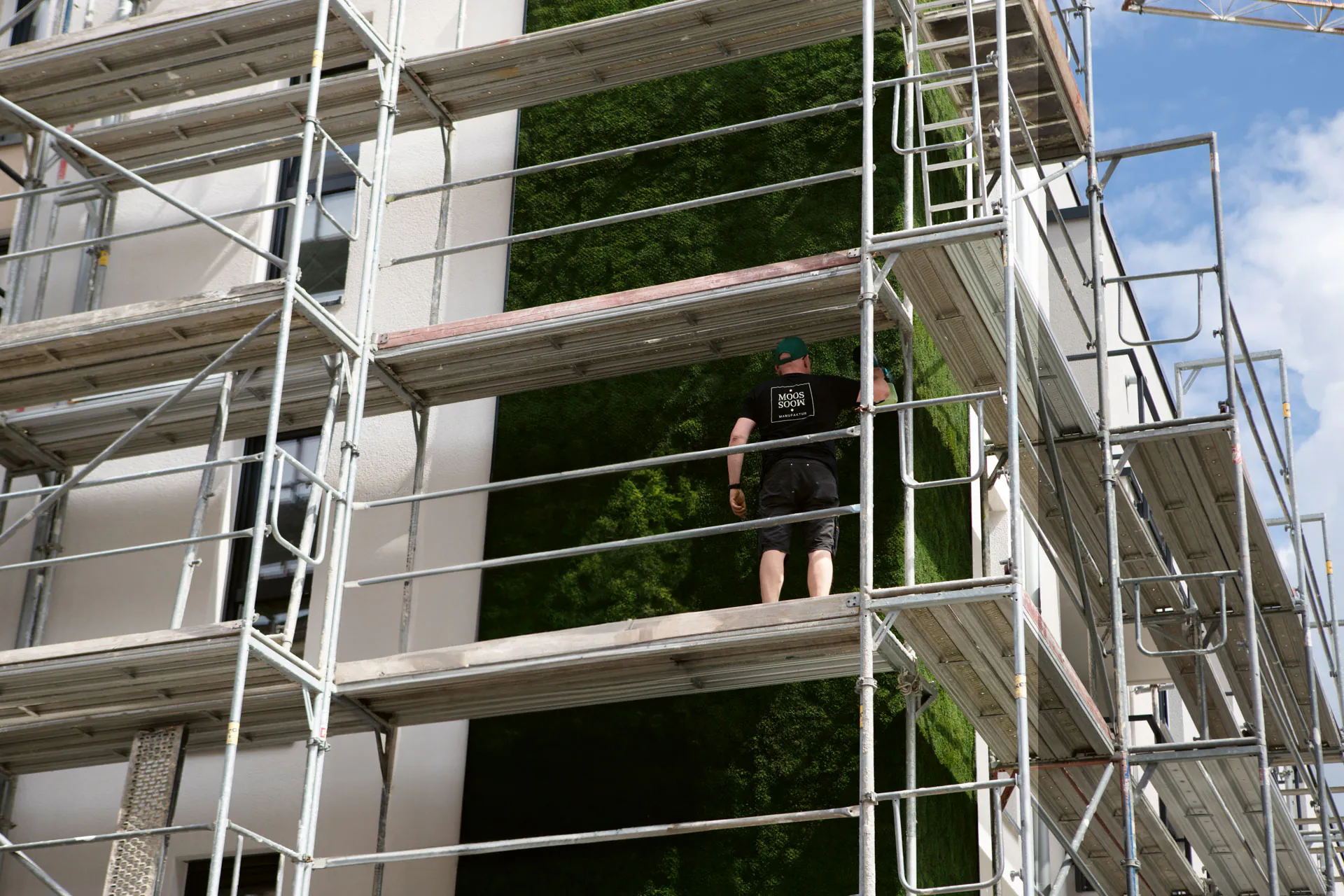
Four advantages for the urban environment
A better urban environment
Plants absorb solar radiation and reduce heat stress. They release moisture through transpiration, increase humidity and can reduce wind speed — and thus the wind chill effect in winter.
Better air quality
Green façades absorb pollutants such as carbon dioxide, nitrogen oxides and particulate matter, thereby improving air quality — which reduces the risk of respiratory diseases.
Improved aesthetics
A green façade is a natural eye-catcher; it breaks up the monotony of the urban landscape and enhances a building’s appearance.
Less noise
Plants absorb sound waves and reduce the noise level in the surrounding area — a noticeable difference on busy roads.
Why conventional greening fails in the city
Climatic conditions
Not every plant is suitable for a façade: sunlight, temperature and rainfall determine which plants to choose — and some species can trigger allergies.
Technical aspects
Installation requires specialised techniques and materials; the planting must not damage the façade — particularly in the case of historic buildings.
Maintenance & Care
Watering, fertilising, pruning, cleaning: maintenance is the most costly aspect of living green façades and must be factored into the budget over a number of years.
Why Greenovation solves the urban façade differently
Preserved moss overcomes precisely the three obstacles associated with living vegetation: no climate-related risks, no substrate, no maintenance — whilst retaining its full natural effect.
No maintenance required
Preserved moss requires no watering, no fertiliser and no pruning — once installed, the façade is self-sustaining.
High resilience
Extremely resistant to temperature fluctuations and precipitation — performs well even in ski resorts with snow and sub-zero temperatures. Also ideal for shaded or poorly ventilated areas.
Compact design
No deep planter, no root system: preserved moss works just as well on small sections of façade.
Air Purification & Noise Reduction
The moss absorbs pollutants and washes them away — whilst also acting as a natural sound barrier.
Which building in your city deserves greenery?
From office blocks to noise barriers: in ten minutes, we’ll determine the scope, system and budget for your project.